Search This Blog

Showing posts with label History. Show all posts

Saturday, January 06, 2007

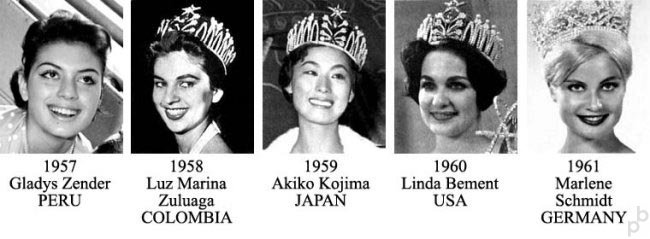
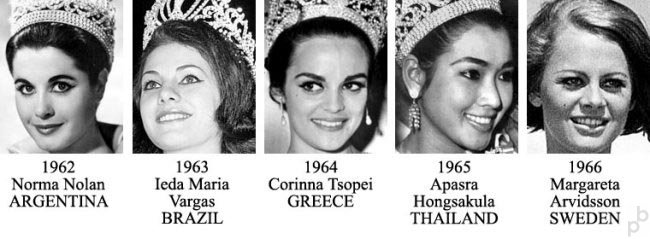
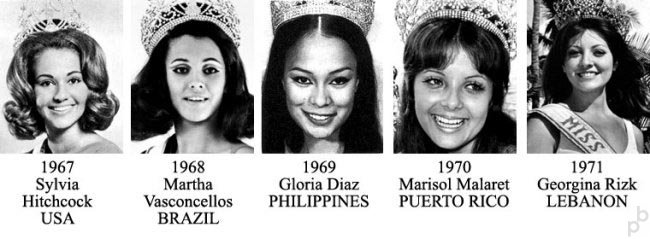
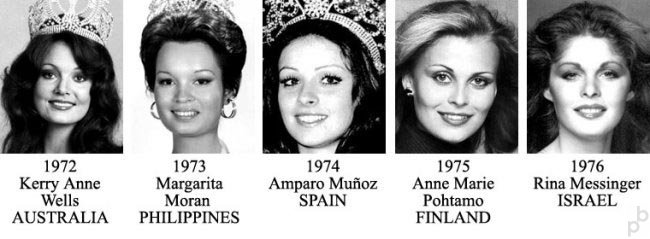
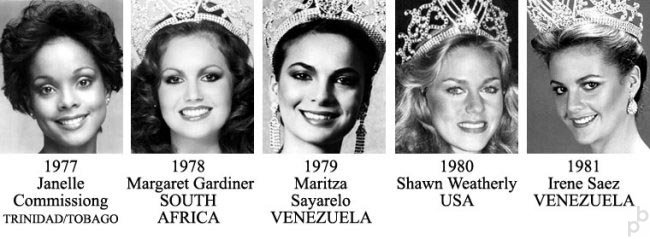
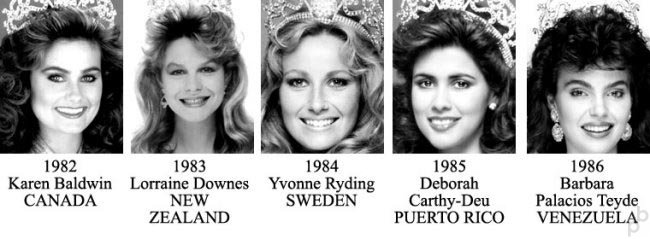
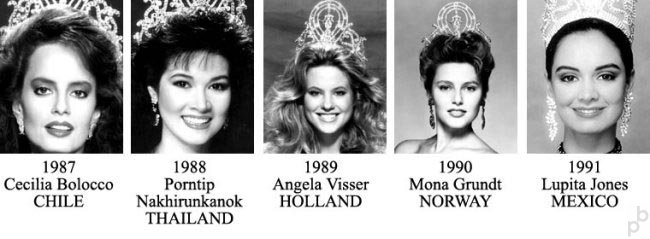
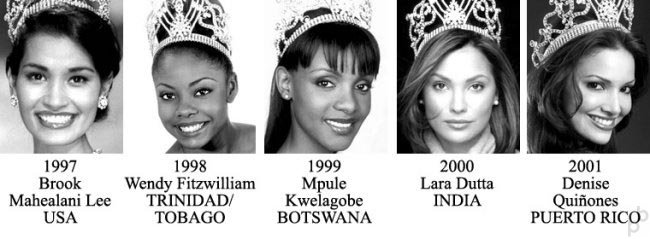
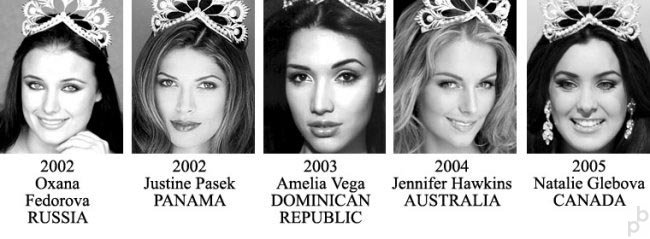
HISTORY : Miss Universe TitleHolders

. Saturday, January 06, 2007
0 comments

[Right click on images 'open new window' to enlarge]

Miss Universe

Miss Universe is an annual international beauty contest, and the title for the winner of the contest, founded in 1952 by California clothing company Pacific Mills. The pageant became part of Kayser-Roth and then Gulf and Western Industries, before being acquired by Donald Trump in 1996. Despite its historical rivalry with the Miss World contest, Miss Universe retains unparalleled prestige in many parts of the world, particularly Asia and Latin America[citation needed]. The reigning Miss Universe is Zuleyka Jerris Rivera Mendoza, representing Puerto Rico. This event is sometimes referred to as the World Cup of Beauty.

History

The winner of 1950's "Miss America 1951" pageant, Yolande Betbeze, refused to pose in a swimsuit from major sponsor Catalina swimwear. As a result, the brand's manufacturer Pacific Mills withdrew from Miss America and set up the Miss USA and Miss Universe contests. The first Miss Universe Pageant was held in Long Beach, California in 1952. It was won by Armi Kuusela from Finland, who gave up her title to get married to a Filipino tycoon, Virgilio Hilario, shortly before her year was complete. Until 1958 the Miss Universe title (like Miss America) was post-dated, so at the time Ms. Kuusela's title was Miss Universe 1953.
The pageant was first televised in 1955. CBS began nationally broadcasting the Miss USA and Miss Universe pageants combined from 1960, and separately from 1965. In 2003, NBC took over the television rights.
The main pageant was held in the United States until 1972, when it was held in Dorado, Puerto Rico. Since then it has usually been held in a different city each year, though Manila, Los Angeles, Las Vegas, Bangkok, and Panama City have each hosted it twice.

The Crown

Design by Mikimoto. The official jewelry sponsor of the Miss Universe Organization.[1] Kept by the Miss Universe Organization to be used in the crowning of the new Miss Universe every year. Valued at $250,000. 800 diamonds, almost 18 carats. 120 pearls South Sea and Akoya pearls, ranging in size from 3.0 - 18 mm. Design depicts the phoenix rising, which signifies status, power and beauty. The Crown was designed specifically for the pageant on Mikimoto Pearl Island in Japan, Mikimoto crown and tiara first used for Miss Universe 2002.

Miss Universe 2006

The 2006 Miss Universe Pageant took place in Los Angeles, California on Sunday, July 23rd in the Shrine Auditorium. This was the first time since 1998 that the pageant was held in the United States and it was also the second time to have been held in Los Angeles.
Puerto Rico's Zuleyka Jerris Rivera Mendoza won the crown.
The first runner-up was Japan's Kurara Chibana, followed by Switzerland's Lauriane Gillieron. The third runner-up was Paraguay's Lourdes Arevalos and the fourth runner-up was USA's Tara Conner.
Miss Philippines, Lia Andrea Ramos, was chosen as Miss Photogenic; Japan's Kurara Chibana as Best National Costume; and Ghana's Angela Asare as Miss Congeniality.

Read more »»

Sunday, December 24, 2006

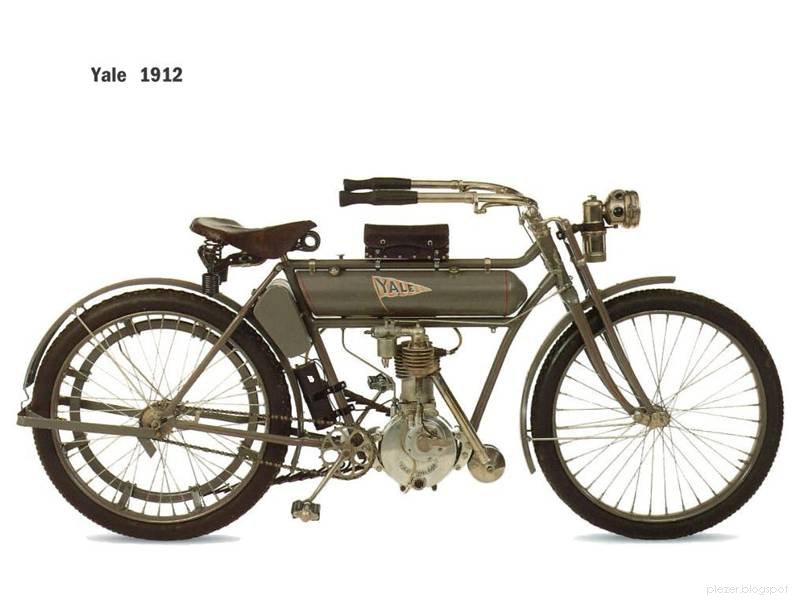
HISTORY: Beautiful Old Bikes

. Sunday, December 24, 2006
0 comments

[Right click on images 'open new window' to enlarge]




History
The inspiration for the earliest dirt bike, and arguably the first motorcycle, was designed and built by the German inventors Gottlieb Daimler and Wilhelm Maybach in Bad Cannstatt (since 1905 a city district of Stuttgart) in 1885. The first petroleum-powered vehicle, it was essentially a motorized bicycle, although the inventors called their invention the Reitwagen ("riding car"). They had not set out to create a vehicle form but to build a simple carriage for the engine, which was the focus of their endeavours.
However, if one counts two wheels with steam propulsion as being a motorcycle, then the first one may have been American. One such machine was demonstrated at fairs and circuses in the eastern US in 1867, built by Sylvester Howard Roper of Roxbury, Massachusetts. There is an existing example of a Roper machine dated 1869. But there is no patent existing and nothing proves it was working. It's powered by a charcoal-fired two-cylinder engine, whose connecting rods directly drive a crank on the rear wheel. This machine predates the invention of the safety bicycle by many years, so its chassis is also based on the "boneshaker" bike. In 1868, the French engineer Louis-Guillaume Perreaux patented a similar steam-powered motorcycle, probably invented independent of Roper. In his case a patent exists (dated 1868), but nothing indicates his invention had moved before 1871. In 1894, the Hildebrand & Wolfmüller became the first motorcycle available for purchase.
In the early period of motorcycle history there were many manufacturers as producers of bicycles adapted their designs for the new internal combustion engine. As the engines became more powerful and designs outgrew the bicycle origins, the number of motorcycle producers increased.
Until the First World War, the largest motorcycle manufacturer was Indian. After that, this honour went to Harley-Davidson, until 1928 when DKW took over as the largest manufacturer. BMW motorcycles came on the scene in 1923 with shaft drive and an opposed-twin or "boxer" engine enclosed with the transmission in a single aluminum housing (photo right).
After the Second World War, the BSA Group purchased Triumph Motorcycles in 1951 to become the largest producer of motorcycles in the world claiming "one in four". The German NSU was the largest manufacturer from 1955 until the 1970s when Honda became the largest manufacturer -- a title it holds to this day. British manufacturers (Triumph, BSA, Norton) retained a dominant position in some markets until the rise of the Japanese manufacturers (led by Honda) in the late 1960s and early 1970s, who were able to produce designs more quickly, more cheaply, and of better quality than their competitors. The British manufacturers became defunct as mass-market producers.
Today the Japanese manufacturers, Honda, Kawasaki, Suzuki, and Yamaha dominate the motorcycle industry, although Harley-Davidson still maintains a high degree of popularity in the United States. Recent years have also seen a resurgence in the popularity of many other brands including BMW, Triumph and Ducati, and the emergence of Victory as a second successful mass-builder of big-twin American cruisers.

Read more »»

Monday, November 27, 2006

HISTORY: Titanic News Paper [1912]

. Monday, November 27, 2006
0 comments

[Right click on images 'open new window' to enlarge]


Introduction
Just a few words about the present exhibit. Serious scholarly effort is not represented here, but rather an attempt to highlight the potential of newspapers as sources for historical and cultural research.
Why an exhibit about the Titanic? Its a great human story, with cultural significance, enduring appeal, old and new controversy, and very well covered in newspapers.
These images represent first and foremost a story. The Titanic sank on April 14, 1912, off the coast of Newfoundland. The story is full of the pathos of 1500+ casualties, the heroism and/or cowardice among the passengers and crew; the very real questions relating to cause and effect; and the continuing aftermath.
But the sinking of the Titanic is more than an isolated historical event. She was the product of early 20th century industrial vigor, a concrete sign of western progress which supported a naive confidence in the boundless limits of technology in man's conquest over nature. The disaster has been interpreted as a metaphor for the failure of industrial civilization to build itself into a better unsinkable tomorrow!
The images themselves represent a sort of social history, 1912 caught in the amber of newsprint. In this context it is not just a question of what is covered--society, fashion, world events--but how the news is conveyed, these images reveal a past era's norms of public expression.
Lastly, there is the simple issue of preservation. Newsprint is a fragile and transitory but invaluable resource for this sort of factual and cultural information. This exhibit will underscore the potential of newspapers for research and the challenge they may present to students and researchers. To this end no heroic efforts have been made to produce the best images possible, but to produce a serviceable image from microfilm. Many newspapers exist on poorly produced or maintained film, researchers and students face this problem everyday!. The images reproduced here illustrate the need to preserve our heritage in a stable and durable medium which maintains content as well as format.

Read more »»

Friday, October 27, 2006

INFO: Telephone History

. Friday, October 27, 2006
0 comments

join [ghoomar] group

Telephones are instruments which work using sound. You put your voice into the electric current which then passes along a wire and is reconverted into sound at the other end. In 1876 the early telephone was discovered by a man call Alexander Graham Bell. He was interested in using telephones to help deaf people.

The First Telephone
This was the first telephone made in 1876 by Alexander Graham Bell.


An 1882 Wall Phone
The Wall Phone had a hand-held receiver and crank to signal the operator.


A Dial Telephone
The Dial Telephone was developed in 1919 .

The 1928 Desk Telephone
The Desk Telephone combined the receiver and transmitter in a handset unit.

The "300" model

The Model desk phone was introduced in 1937 and contained a bell in its base.

The Coloural Telephone
The Coloural Telephone of 1954 gained widespread popularity as a decorative item.

The "Trimline" Telephone
The Trimline Telephone of 1968 featured push buttons on the handset.

join [ghoomar] group

A Touch-A-Matic Phone
The Touch -a-Matic Phone of 1973 dialed a number at the push of a button.

join [ghoomar] group

How to make a simple telephone set for your kids

You can make a private telephone line with some string and two empty tins. Firstly, cut off the tops of the cans and punch a small hole in the bottom of them. Next, thread the ends of the string through the holes and tie a knot inside each can . Lastly, go away from each other and talk to your friend. Each person should hold one can each. The cans are receivers for speaking into.

Read more »»